

The ‘Smartest’ Parenting Pill: Read aloud to your children
Once upon a time, a large group of parents were told, “There is a new ‘smart pill’ to be given to your child from age 0 to 6. That it is 100% guaranteed to make your child smart. But it’s really expensive. So take your cheque books and go and get it from the school principal’s cabin.”
Parents made a beeline for the ‘smart pill’. The line was very long. Everyone wanted the pill. One by one, every parent entered the cabin and was given a sealed envelope and asked to deposit the cheque in a box outside the cabin.
After exiting the principal’s cabin, the parents were asked to open the sealed envelope. Inside was a simple piece of paper that said- “Read to your child 30 minutes a day. This is the most expensive gift you can give your child.” Turns out, there was no cheque to be given. And yet, in that moment, every parent felt the weight of the promise they were asked to make. Because this is the simple truth, reading aloud to children from ages 0 to 6 fosters profound developmental advantages, from language mastery to emotional bonds. This simple daily practice cultivates lifelong cognitive skills, outpacing other activities in building neural foundations for learning.
Reading aloud exposes young children to rich vocabulary and complex sentence structures they wouldn’t encounter otherwise, accelerating language acquisition by up to 1.4 million words by kindergarten for frequent readers. It sharpens listening skills, critical thinking through plot prediction, and memory via narrative recall, while sparking imagination as children imagine stories in their minds. Social-emotional growth thrives too, with stronger parent-child bonds, empathy from character insights, and reduced stress, all enhancing focus and school readiness.
Three Things you need to keep in mind
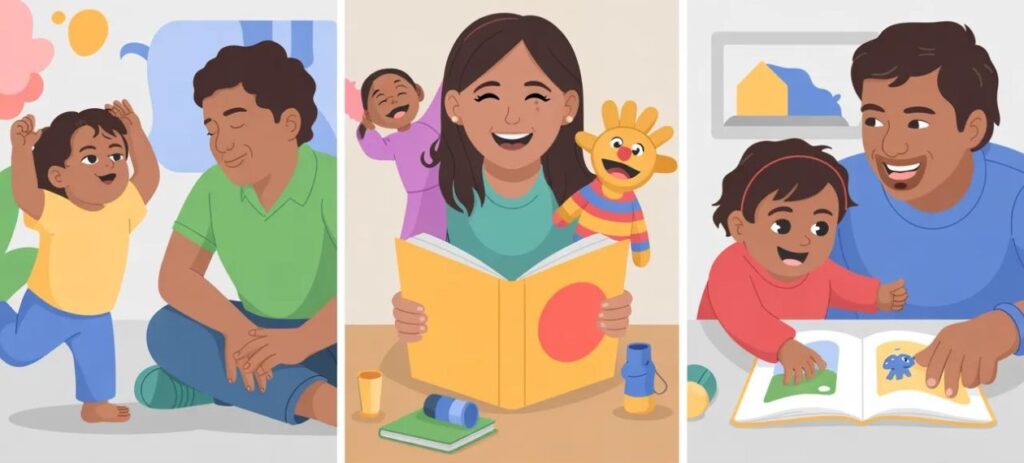
- Don’t demand silence or stillness: Children this age won’t sit still—expect wiggles, as their bodies crave movement. Do make it interactive: pause for questions, mimic animal sounds together, or let them “read” by turning pages and describing pictures, boosting participation and ownership.
- Make it vibrant and joyful: Do vary tones, gestures, and props like puppets to hold attention during short 10-15 minute sessions.; it frustrates them. Don’t read monotone or rush—expressive delivery captivates.
- Let them express themselves too: Instead of forcing eye contact, follow their lead, weaving in play to sustain engagement without pressure.
What Neuroscience Says

The very act of reading aloud to children before they can read, makes them curious about why something is being read to them and why they can’t read it themselves instead. So a desire to read is born. Listening also sculpts the developing brain by strengthening neural pathways in language centers like Broca’s and Wernicke’s areas, enhancing connectivity between auditory processing and prefrontal cortex for executive function. It activates the default mode network for imagination and social cognition, and also boosts faster signal transmission, critical in the first six years when connections grow rapidly. Repetitive story exposure refines sound awareness, which forms the basis for phonics.
Imagine all of this being ‘cancelled’ by the simple act of handing over a smartphone to the child in the early years and numbing and dumbing their brain. Introducing devices at 0-6 disrupts the sensitive period for language and attachment, correlating with 20-30% attention span reductions and delayed vocabulary per meta-analyses of 50+ studies.
Scientific consensus is clear- no smartphones before age 10-12, with optimal delay until 14 for attention and impulse control benefits. Further, evidence from the famous ABCD Study tracking 10,000+ kids, links pre-age 10 screen exposure to thinner cortex in executive regions by adolescence! This may heighten ADHD risk by 2-3x.
Smarter, Happier Children
During age 0-6, ‘zero recreational screen time’ is recommended, so as to prioritize interactive activities like play and reading. No activity rivals reading aloud for forging lifelong cognitive prowess. Harvard research shows that daily readers from infancy score 6-12 IQ points higher in adulthood, with 3.4 times better vocabulary and comprehension.
Reading builds “crystallized intelligence” via cumulative knowledge, outperforming puzzles or apps, as brain plasticity peaks early. Children who miss this have to play catch-up all their lives because readers acquired 25% more cognitive skills by grade 3, such as abstract thinking, problem-solving, sowing the seeds of resilience and emotional strength.
No wonder that readers become leaders
Comments are closed