
Is India Facing a Generational Cognitive Decline?
Quick Answer
India is not facing a proven, nationwide drop in intelligence. That strong claim is not backed by clear evidence. The real picture is more specific, and it differs by age group. Among older adults, research does link late-life cognitive impairment to early hardship and low schooling. Among children, the main concern is weak foundational learning, not mental decline. Across all ages, daily habits like heavy screen use, poor sleep, and dirty air may strain focus and memory over time, but researchers study these one at a time. The popular idea that no generation is spared comes mostly from media coverage, not from one clear study. So the honest answer is careful. India faces real and separate cognitive risks, not a single, proven generational collapse of intelligence.
A worrying idea is spreading online. It says India is losing its thinking power, and that no generation is safe. The claim sounds urgent and scary. But a scary claim is not the same as a proven fact.
This gap matters. When people mix fear with facts, they either panic or ignore the real problems. Both responses hurt. So this article does something simple. It separates what research actually shows from what the headlines shout.
The truth is more careful than the fear. India does face real pressure on how people think. But this pressure is specific. It affects different age groups in different ways, and it has clear causes that research can name and study one by one.
The better question is not whether Indians are getting less intelligent. It is this. Which thinking skills are under real pressure, for whom, and why. This article looks at what the evidence says, what is truly pressing on Indian minds, and how the country can protect its thinking power through 2030.
What does “cognitive decline” actually mean?
The phrase gets used loosely, and people stretch it to cover very different things. Sorting these out prevents needless panic.
Cognitive decline versus weak learning versus normal aging
These three are not the same. Cognitive decline means a real fall in memory, focus, or reasoning over time. Weak learning means a child never gained a skill in the first place. Normal aging means small, expected changes late in life, and age itself is not a disease. A child who reads poorly is not in mental decline. An older adult who slows down a little is not in crisis. Clear words keep the discussion honest.
What does current research actually tell us about India’s cognitive health?
Before judging the fear, it helps to see what studies actually say. The evidence points in four clear directions.
Older adults face real, measured risks
Research does show genuine concern for older adults. One peer-reviewed study of older Indians links late-life cognitive impairment to childhood deprivation and low schooling. This finding is specific and serious. It is about aging brains shaped by early hardship, not about a whole generation losing intelligence at once.
Children face learning gaps, not mental decline
For children, the concern is foundational learning. National ASER 2024 data shows that reading levels dipped in 2022, after the pandemic, then recovered across states by 2024. The World Bank’s Learning Poverty work also shows weak foundational reading across many low and middle income countries. So the picture is a weak base that is improving, not a mind in decline.
Lifestyle factors are studied one at a time
Attention, sleep, air pollution, and heavy technology use are all studied as possible risk factors. Each may affect focus or memory in its own way. But researchers study them separately, with their own limits, and they should not be collapsed into one giant cognitive decline label.
The “no generation spared” claim is mostly a media narrative
Much of the alarm traces to one widely shared source. In August 2025, an India Today feature described a mass cognitive decline in which no generation is spared. It combined worries about aging, education, attention, pollution, and technology into one broad story. Each concern deserves attention. But a stack of separate, partial worries is not the same as one proven, nationwide decline in intelligence.
Put together, the honest summary is short. Real and separate risks exist, and they deserve serious attention. A single, proven, nationwide decline of intelligence does not.
What is genuinely putting pressure on Indian minds today?
Clearing the hype does not mean all is well. Real pressure exists. It is just more specific than the headlines suggest.
Attention and the pull of screens
Phones sit inside an attention economy designed to hold focus. Frequent interruptions and constant task-switching may make sustained concentration harder, especially when screen use repeatedly replaces sleep, reading, or focused study. This does not mean phones lower raw intelligence. It means the conditions for deep focus become harder to maintain.
Foundational learning still needs work
The base skill of reading is still weak for many Indian children, even after the recent recovery. Because every subject rests on reading, a weak reading base can slow later learning. This is a real risk. But it is a learning gap that schools can close, not a decline of the mind.
Sleep, pollution, and daily lifestyle load
Daily life adds quiet loads on the brain. Poor sleep, high stress, and air pollution can all affect focus and memory. A 2025 systematic review and meta-analysis found that long-term exposure to air pollution is linked to a higher risk of cognitive impairment. No single factor decides everything, but together they can wear down the conditions a healthy mind needs.
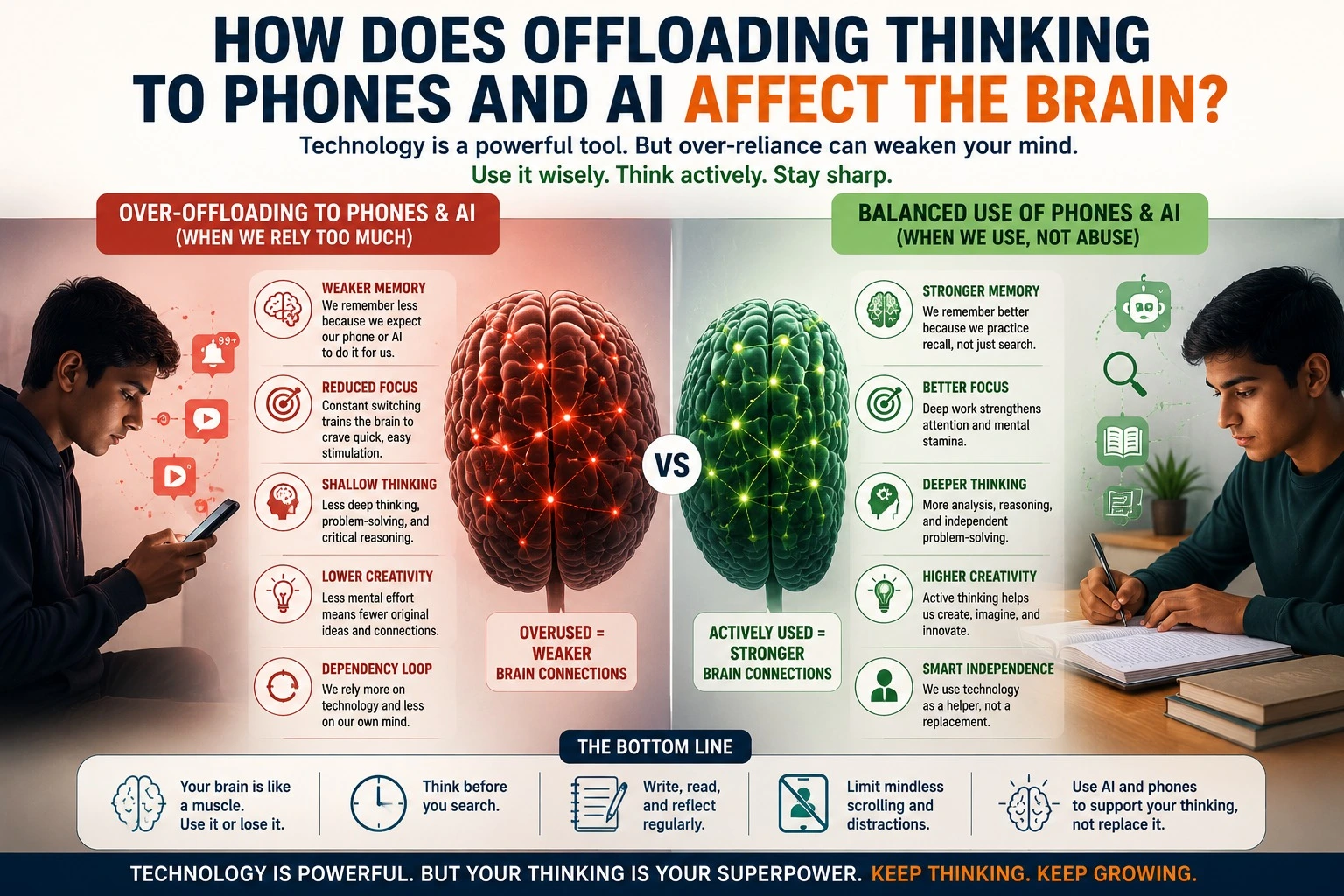
How does offloading thinking to phones and AI affect the brain?
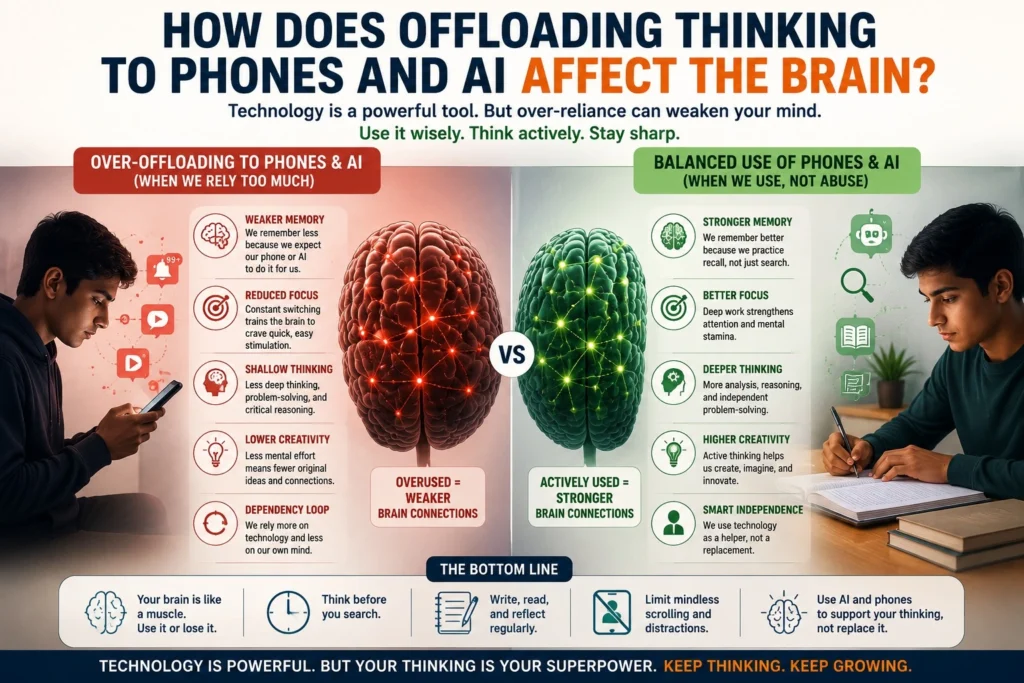
One modern habit deserves a careful look. More and more, people let devices remember and decide for them. The effect is not simple.
Cognitive offloading is not automatically harmful
Cognitive offloading means letting a tool store a fact or handle a task for you. Humans have always done this, through writing, calculators, calendars, and maps, and it can free mental effort for harder work. A meta-analysis of the so-called Google effect found that when people expect to look something up, they often recall the fact itself less well, while remembering where to find it. So offloading changes how memory works more than it simply destroys it.
When offloading turns into a real risk
The risk appears when people repeatedly replace active recall, reasoning, or problem solving with automatic answers, and stop practising those skills at all. Convenience is not the enemy. The concern is a habit of never thinking for oneself. The fix is not to drop the tool. It is to keep using one’s own mind alongside it. For a growing mind this matters even more, because young brains are still building the very skills that constant shortcuts can leave unpractised.
Why will this matter more between 2026 and 2030?
This pressure is not new. But the fast spread of AI into daily life may raise the stakes, so it is worth looking ahead with care.
What we know, and what we are still guessing
Here it helps to be honest about certainty. Researchers are still studying the long-term effects of everyday AI use, and current evidence does not prove that AI causes broad cognitive decline. What researchers and educators do raise as a concern is this. If people lean on automated answers for most of their thinking, they may get fewer chances to practise independent reasoning, memory, and problem solving.
The gap between minds that depend and minds that guide
This points to a possible split by 2030. Some people may simply accept whatever AI produces. Others may read, question, and check it. AI can supply information and draft answers, but humans still need judgment to weigh evidence, understand context, and decide when an answer can be trusted. The people who keep that judgment sharp are likely to gain the most from AI, rather than be replaced by it.
Why are the first nine years important for cognitive development?
Much of the foundation for lifelong thinking is laid very early. The first years of life shape how well a mind learns later.
Rapid early brain and language growth
In early childhood, the brain grows and forms connections at a remarkable pace. This is also when children build language, and language is the tool the mind uses to think. Rich talk, play, and stories in these years support attention, vocabulary, and memory, and they set the stage for all later learning. Weak support in these early years is harder to make up later, which is why early care and early reading carry such long shadows.
Foundational literacy and habits take root early
These years are also when foundational literacy begins. Children who learn to read early, in a language they understand well, build a base that makes later learning easier. Policy reflects this. UNESCO’s 2025 State of Education Report for India notes that the National Education Policy 2020 emphasises the mother tongue as the main medium of instruction until at least Grade 5. Daily habits, including a habit of reading, also form most easily in these early years.
How can India protect and strengthen its next generation’s thinking?
The good news is plain. Thinking skills can be practised and protected. A few steady habits can help a whole generation over time.
Reading as steady practice for the mind
Regular reading gives the brain repeated practice at sustained attention, comprehension, and reflection. Over time, these habits may support the very thinking skills that fast media can crowd out. Reading is not a magic cure, but it is one of the simplest daily ways to keep a mind active and engaged. The key is regularity, not length, because the brain gains most from steady, repeated practice rather than rare long bursts.
Stronger schools and early language
Strong thinking rests on strong early schooling. Schools that protect time for reading, and that teach early in a language children understand, give every child a firmer base. When that base is solid, later subjects come more easily, and children stay in learning longer.
Balanced tech habits and shared reading
Balance matters more than banning. Fixed screen limits, better sleep, and daily reading can protect focus far more than any single big effort. Reading movements help by making the habit social and shared, so it spreads from one home to a whole community.
What role do reading and reading movements play in national thinking?
Habits need carriers. Reading movements and mentors help carry the reading habit from single homes into a wider culture.
Reading movements and a stronger reading culture
Across India, families, schools, libraries, and book clubs are working to rebuild a reading culture. Bharat Padho Abhiyan is one such initiative. It promotes daily reading through structured programs for parents, schools, libraries, and book clubs. Efforts like these give people more chances to practise the deep focus that a screen-heavy age can erode.
How reading mentors support the wider goal
Reeta Ramamurthy Gupta, Asia’s First Reading Coach, author, biographer, and columnist, has spent years encouraging reading habits among children, parents, educators, and professionals. Her work supports a broader goal explored in this article. That goal is a culture where people practise sustained reading, independent thinking, and lifelong learning. Habits like these will not settle every scientific question about the brain. But they are among the clearest, most practical ways a nation can help its people keep thinking well.
Frequently Asked Questions
Is India really facing a generational cognitive decline?
Not in the strong sense the phrase suggests. There is no clear proof of a nationwide fall in intelligence across all ages. Real concerns exist in specific areas, such as late-life cognitive impairment in older adults and weak foundational learning in children. The honest answer is careful, not dramatic. Separate risks are real, but a whole generation collapse is not proven. The most useful response is not fear, but steady attention to the specific risks that research has actually identified.
What is cognitive offloading, and is it harmful?
Not automatically. Offloading means letting a device store a fact or handle a task, and humans have long done this with books, calculators, and maps. It can free attention for harder work. The risk appears only when people keep replacing their own recall and reasoning with automatic answers and stop practising those skills at all.
Are smartphones lowering attention spans in children?
Research links some patterns of heavy or poorly managed screen use with attention problems, poor sleep, and less time for reading or focused activity. But screen use does not affect every child the same way, and researchers do not treat smartphones as a simple cause of lower intelligence. Balanced habits matter more than the device alone.
Does reading improve cognitive ability?
Reading gives repeated practice at specific skills, such as sustained attention, comprehension, and reflection. Over time, these habits can support the thinking skills needed for deeper learning. Reading is best seen as steady practice for the mind, rather than an instant boost to general intelligence.
How can parents protect a child’s thinking in the AI age?
Keep the basics strong. Set clear screen limits, protect good sleep, and build a daily reading habit. Let children try to solve small problems on their own before reaching for a device. Early reading in a language the child understands well helps most. Balance, not banning, keeps a young mind sharp.
Will AI make people less intelligent?
Current research does not prove that AI makes people less intelligent. The effect depends on how it is used. If AI does all the thinking, unused skills may get less practice. If people read, question, and check what AI produces, their judgment stays strong. The habit around the tool matters more than the tool itself.
Read Related Article
Comments are closed